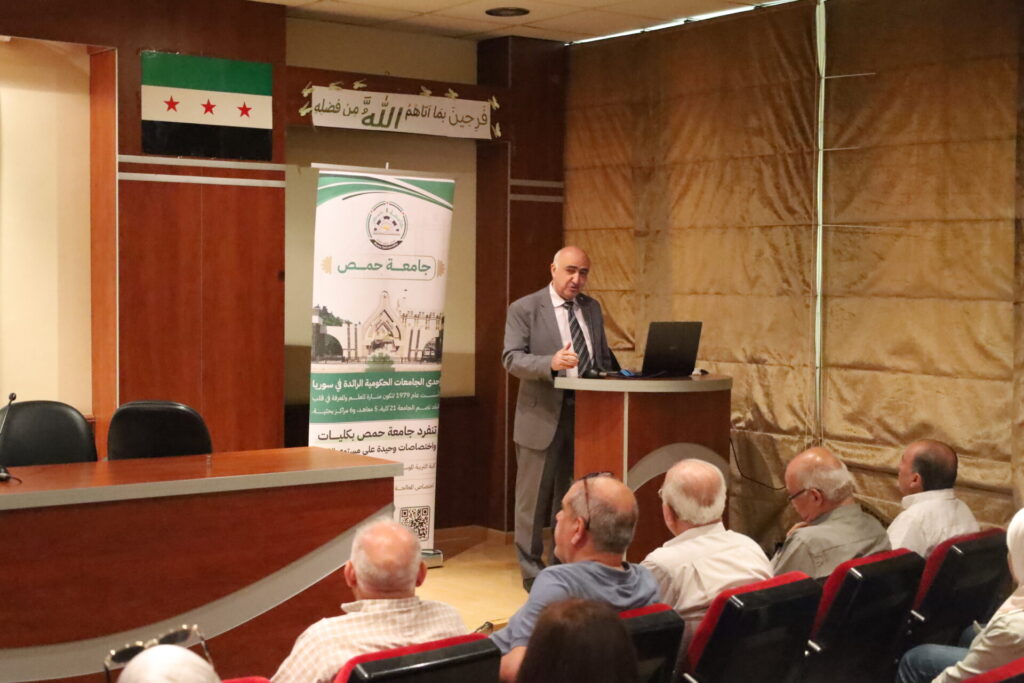
The Faculty of Science at Homs University organized a workshop entitled “Prospects of Artificial Intelligence: From Fundamentals to Innovation”, with the participation of some faculty members, researchers, and students interested in modern techniques and AI applications.
The workshop included a set of scientific lectures covering the fundamentals of artificial intelligence, machine learning, neural networks, and deep learning, in addition to the AI applications in scientific research and productivity and a public debate about the impact of artificial intelligence on the future of humanity.
The university Vice-President for Students and Administrative Affairs, Prof. Ayman Kessibi, emphasized the importance of keeping pace with the rapid scientific and technological developments, indicating that artificial intelligence has become one of the most prominent engines of development and innovation across various. He stressed the need to enhance academic and research awareness in this field. Furthermore, he pointed out the university’s keenness to support digital knowledge, encourage scientific research, and enable students to acquire modern skills qualifying them for competiveness and leadership.
For his part, the faculty dean, Prof. Muhammed Khaled Yazbec, stated that artificial intelligence is one of the most important revolutions in the current era, and that it is no longer merely scientific fiction but it has become the fundamental pillar for scientific and vocational work and development. Moreover, he explained that the workshop constitutes a significant scientific platform for exploring the AI prospects from its theoretical foundations to its latest innovative techniques contributing to advancing scientific research methods, enhancing the ability to accurately and effectively analyze the sophisticated data , thereby supporting the progress of scientific and cognitive advancement.
For her part, the workshop coordinator, Prof. Fatima Shallaf, reviewed the main phases of developing artificial intelligence from the emergence of its early concept to the widespread use of its modern applications, and addressed the concept of artificial intelligence, machine learning and deep learning, and its operative mechanisms, applications and challenges in different fields.
At the conclusion of the event, the importance of ongoing specialized activities in the areas of modern technology and artificial intelligence for its role in developing the students’ academic and research capacities and enhancing its readiness for future requirements.